What October's Cooling Homes Are Hiding Inside Your Walls
Most Las Vegas homeowners breathe a sigh of relief when October arrives. The brutal heat breaks, the AC bills drop, and life gets comfortable again. But inside the walls of thousands of homes across the Las Vegas Valley, something else is starting: a slow, invisible process that turns summer's residual moisture into active mold conditions. Most people never see it coming until they smell it.
Thermal imaging mold detection in Las Vegas is most commonly associated with burst pipes or obvious leaks. That framing misses the most useful window to use this technology all year. October is that window, and the physics behind it are specific to desert climates like ours.
Fall Temperature Swings Create a Condensation Problem Most Homeowners Never Anticipate
During July and August monsoon season, moisture enters Las Vegas homes in ways that aren't dramatic enough to call a plumber. Window frames absorb humidity during rainstorms. Stucco siding wicks moisture inward during multi-day wet spells. Attic spaces collect warm humid air that drifts in through vents. None of this causes an obvious water event. It just sits there, absorbed into building materials, waiting for conditions to change.
When October brings cooler nights and you finally shut off the air conditioning, the thermal dynamics inside your home shift. Walls that spent summer cycling between extreme outdoor heat and heavily cooled indoor air now encounter a new pattern: cool outdoor temperatures meeting walls still releasing stored interior heat. That temperature differential drives condensation inward, toward the cooler surface inside the wall cavity.
That is the condensation window. It is real, it is predictable, and it is brief. Miss it and you are waiting for the smell.
Your Humidity Gauge Is Not Telling You the Full Story
Your indoor air may read a perfectly normal relative humidity level while the inside face of an exterior wall is collecting enough moisture to support active mold growth. Standard humidity gauges measure the air. They tell you nothing about what is happening six inches inside drywall.
Here is what makes October particularly deceptive. Mold grows in the dark, in materials that hold moisture, at temperatures between roughly 40 and 100 degrees Fahrenheit. Daytime highs in the mid-70s and overnight lows dropping into the 50s create a sustained growth environment that summer's 115-degree ambient heat actually suppressed. The conditions that make Las Vegas livable in October are the same conditions that make your wall cavities hospitable to mold for the first time in months.
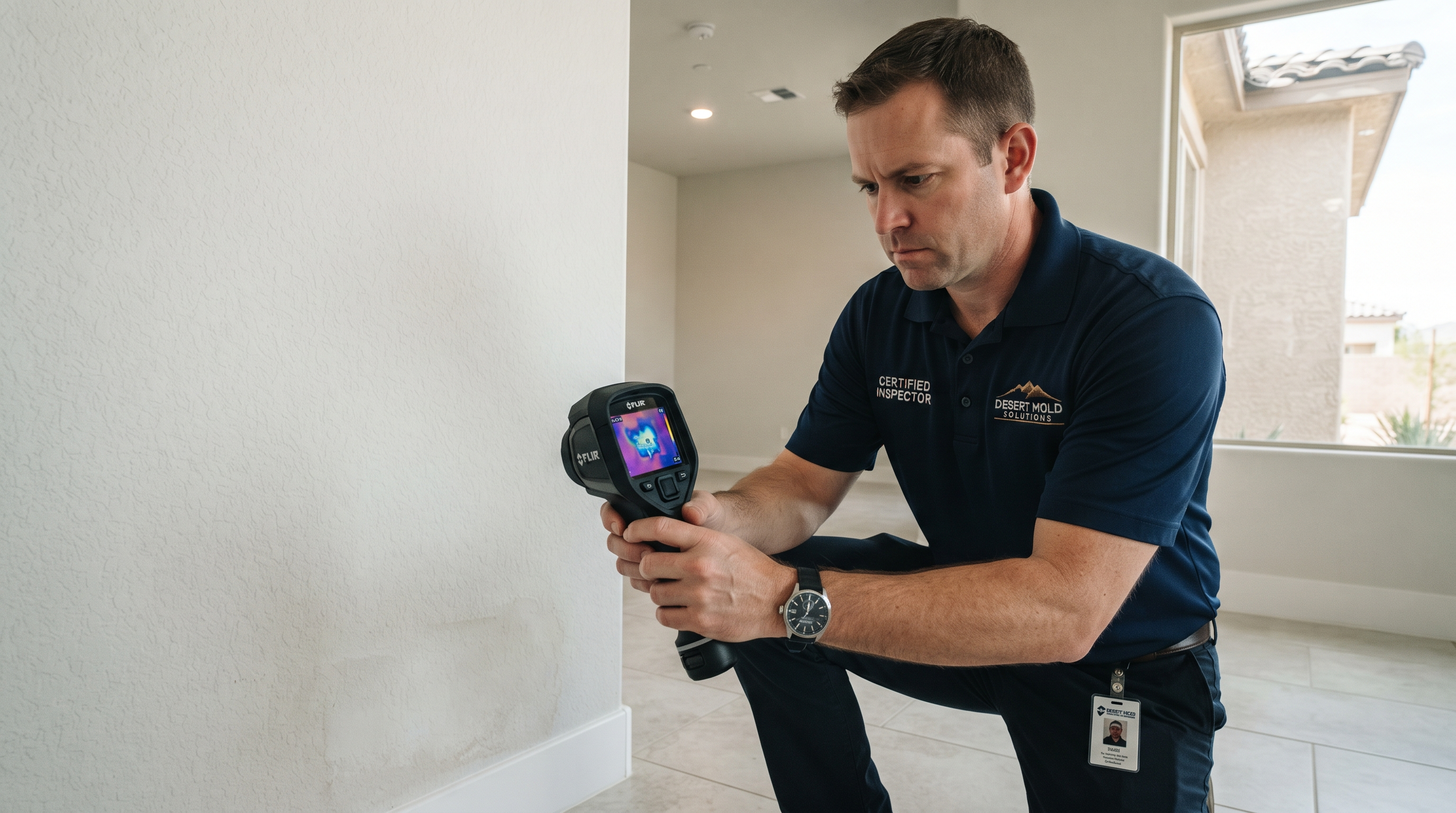
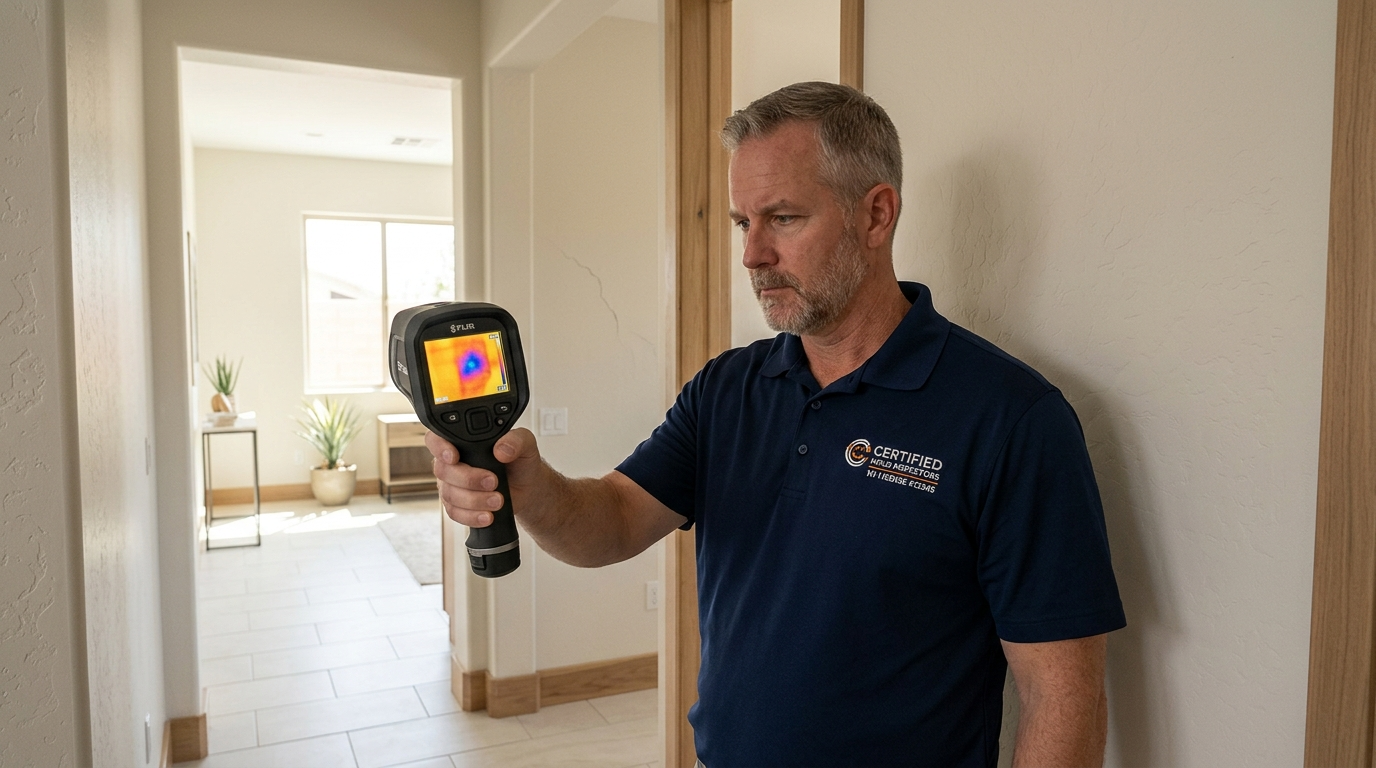
This is exactly why thermal imaging adds something that air sampling and visual inspection alone cannot deliver. A FLIR thermal camera reads surface temperature differentials across walls, ceilings, and floors. Moisture-laden building materials hold and release heat differently than dry materials. That difference shows up as a thermal anomaly, a cool or warm patch that does not belong, long before any visible staining appears and long before mold odor reaches the living space.
Monsoon Season Left Something Behind, Even If You Never Saw a Puddle
Las Vegas received meaningful monsoon rainfall this past summer. Properties in Henderson, Summerlin, North Las Vegas, and the downtown corridor all experienced sustained humidity events that are genuinely unusual by desert standards. Many homeowners watched the rain, confirmed no obvious flooding occurred, and moved on.
The pattern we encounter most often is this: a homeowner contacts us in November or December after noticing a musty smell in a bedroom or hallway. When we run thermal imaging during the inspection, we find a moisture pocket that maps almost exactly to an exterior wall or roof penetration point exposed during the prior monsoon season. The mold has been growing for weeks. The moisture that fed it arrived months earlier.
If you had any water intrusion during monsoon season, even minor, a post-season thermal scan gives you a documented baseline. If something is growing, you find it now before it spreads. If nothing shows up, you have documentation that your property was clean as of that date, which matters during a sale or a dispute. For context on why documented results carry weight, see what makes a mold test court defensible.
What Thermal Imaging Finds That a Visual Inspection Cannot
A visual inspection of your walls shows you exactly what is on the surface. Thermal imaging shows you what is happening behind them without opening a single panel. A certified inspector moves through the property with a FLIR camera, methodically scanning each exterior-facing wall, ceiling plane adjacent to the roof, and floor slab edge where ground moisture can migrate inward.
Anomalies get flagged and documented. Flagged areas are then confirmed with a moisture meter, which physically measures moisture content at that specific point. This two-step process separates genuine moisture pockets from thermal artifacts caused by insulation gaps or HVAC discharge patterns. The result is a written report that identifies where moisture is present, at what level, and whether air sampling is warranted to determine if mold colonization has begun.
Las Vegas Mold Testing does not perform remediation. We test, document, and report. That independence matters because you receive findings from a certified professional who has no financial reason to alarm you. To understand why certification matters in that context, see why mold inspector certifications matter.
Questions Las Vegas Homeowners Ask Before Scheduling a Thermal Scan
I don't see any mold and my house smells fine. Do I actually need this?
Mold odor is a lagging indicator. By the time you smell something, the colony is already established and has been producing spores into your air for some time. No visible sign and no odor in October means you are still in the detection window, which is the best possible position to be in. A thermal scan now costs significantly less than remediation after the smell appears.
Can't I just buy a thermal camera and do this myself?
Consumer thermal cameras have improved significantly and can detect major temperature differentials. What they cannot do is interpret what those differentials mean in the context of mold risk, distinguish thermal artifacts from genuine moisture signatures, or produce a report with the credentials needed to support an insurance claim or a real estate transaction. The camera is one tool. The certified inspector using it is the service.
I had a roof repair done after last monsoon season. Doesn't that mean I'm fine?
A repair addresses the entry point. It does not address moisture that entered before the repair was completed. Roofing materials, insulation, and drywall can hold moisture for weeks after a repair. If the work happened in August or September, October is actually the first month where conditions are right to detect what that moisture is doing inside your wall assembly.
If I call and you find mold, am I going to be pressured to hire a remediation company?
No. Las Vegas Mold Testing does not perform remediation and does not refer clients to remediation companies for compensation. If we find active mold growth, we document it, give you the report, and explain what the findings mean. What you do with that information is your decision. That separation is the reason clients hire us when they want a straight answer rather than a sales pitch.
How long does a thermal imaging inspection take?
For a standard residential property in the Las Vegas area, the inspection typically runs between 90 minutes and two hours depending on the home's size and construction. You receive a written report documenting thermal anomalies, moisture readings, and recommendations. If air sampling is collected, lab results follow within a few days.
Schedule Before the Diagnostic Window Closes
October and early November represent the most useful period for thermal imaging in the Las Vegas Valley. The temperature differential between outdoor and indoor surfaces is at its widest. Moisture that survived summer is still present in building materials. Mold growth conditions are active for the first time in months, and you still have time to catch it before it spreads.
Las Vegas Mold Testing performs FLIR thermal imaging as a standalone service and as part of our full mold inspection package. We serve homeowners, property managers, and buyers across Clark County, including Henderson, Summerlin, North Las Vegas, and surrounding areas.
Call (702) 766-8030 or schedule online to book your October thermal scan. You receive a written report documenting exactly what was found, regardless of the outcome.
Contact Form
Check Out Our Other Environmental Blogs!