Your Well Water May Be Contaminated Most Mold Inspections Will Never Check It
Most mold investigations start and end at the walls. Inspectors look for visible growth, pull air samples, and check HVAC returns. When results come back clean, homeowners are told they do not have a mold problem. But if you are on a private well in Pahrump or the outer edges of Clark County and you are still waking up congested every morning, the investigation stopped too soon. Well water quality testing in Las Vegas Nevada and the surrounding rural areas is rarely part of a standard mold consultation, and that gap leaves an entire contamination pathway completely unexamined.
Water drawn from a private well does not pass through a municipal treatment plant. It moves directly into your plumbing, your fixtures, your ice maker, and if you run a whole-home humidifier, it gets aerosolized into the air your family breathes every day. Microbiological contaminants, including bacteria and certain mold species, can travel that entire route from the aquifer to your lungs without leaving a single visible stain on your drywall.
Monsoon Season Creates a Testing Window Private Well Owners Miss
Every summer, the Las Vegas Valley and the communities surrounding it absorb heavy monsoon rainfall. For homeowners on municipal water, that rain mostly means higher humidity and the occasional flooded garage. For private well owners, it means something more consequential. Surface runoff carries biological material, agricultural residue, and sediment into the soil. That material can migrate into shallow wells over weeks, sometimes months, after the storms pass.
If your allergy symptoms tend to flare in September or October rather than during the storm itself, you are probably not reacting to outdoor air. You are reacting to what entered your well weeks earlier and is now cycling through your home. Read more about why mold symptoms spike after monsoon season and what that timing reveals about the actual source.
The pattern we encounter most often is this: a homeowner in Pahrump notices a persistent musty odor starting in early fall, schedules a surface inspection, gets a clean result, and concludes they imagined the problem. The odor is real. The source is just upstream of where anyone looked.
That upstream source is exactly what the next section addresses.
Contaminated Well Water Turns Your Humidifier Into a Delivery System
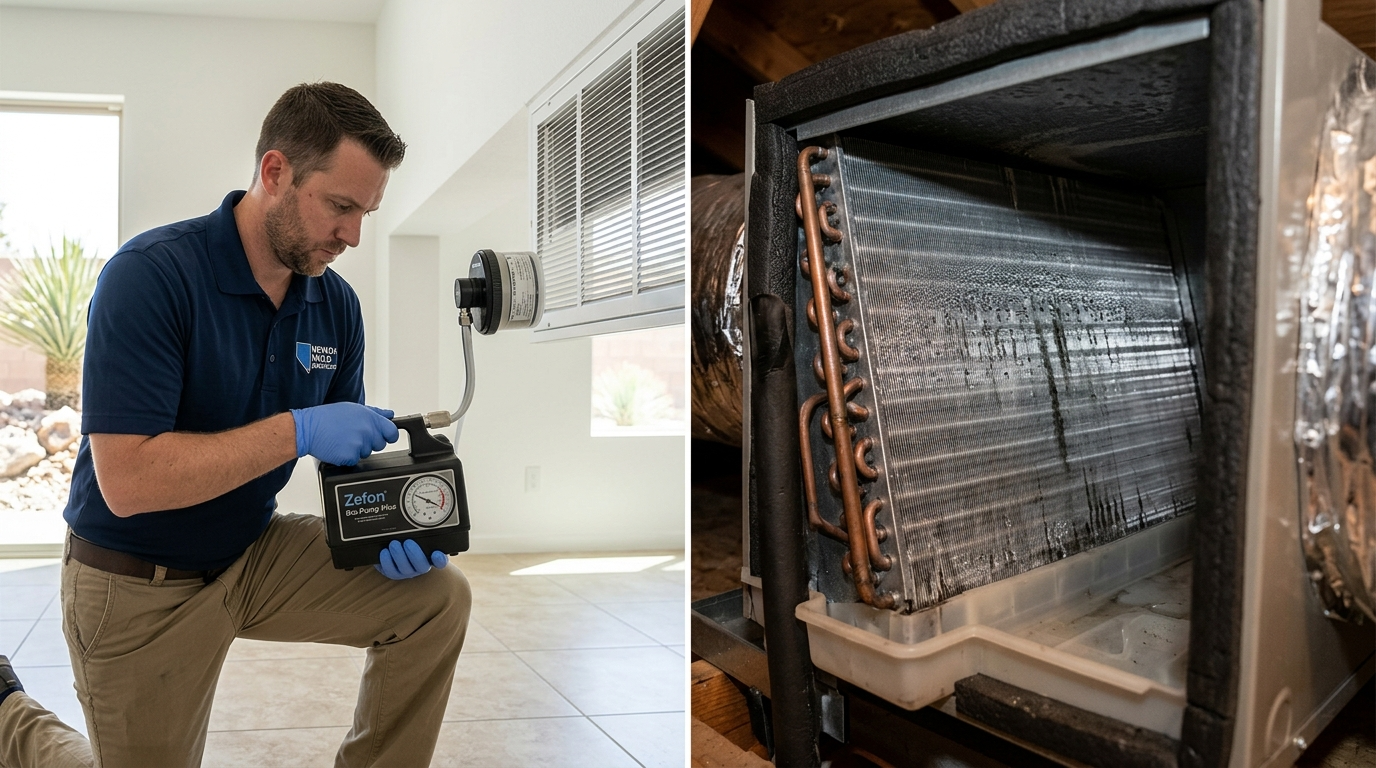
Whole-home humidifiers are common in the Las Vegas Valley. Homes run air conditioning for six months straight, and the desert air strips indoor humidity down to levels that crack wood floors and irritate airways. Humidifiers solve that problem. They also introduce a variable most homeowners never consider: they atomize whatever is in your water supply into fine particles and distribute it through your duct system.
If your well water carries bacteria, VOCs, or biological contaminants at levels above what your filtration system handles, those contaminants become airborne every time the humidifier runs. They settle into duct lining, onto coil surfaces, and into the humid reservoir of the humidifier itself.
An air quality test drawn from a room register captures the output of that system. It does not tell you what went in. This is why indoor air quality testing alone has real limits when the contamination source is upstream in the water supply. The test can confirm a problem exists. It cannot locate where that problem originates. Identifying the source requires testing the water itself, and that means evaluating a specific panel of markers.
What a Well Water Quality Test Actually Measures
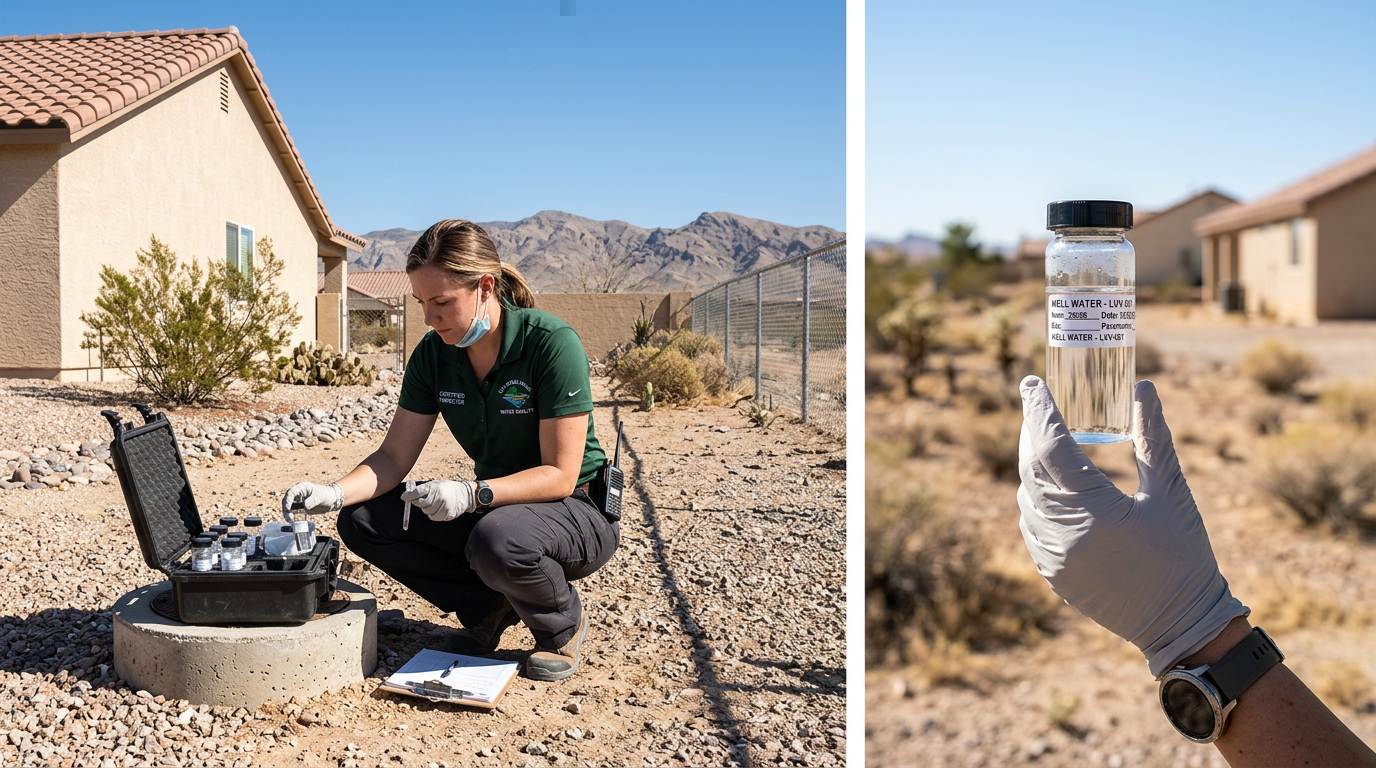
Testing well water for health and mold-related concerns is not a single test. It is a panel of analyses selected based on the property, the well depth, the local geology, and the homeowner's symptoms. At Las Vegas Mold Testing, well water quality testing evaluates the following:
- Bacteria: Total coliform and E. coli are the baseline markers for biological contamination. Their presence indicates that surface-level organic material has entered the well casing.
- Heavy metals: Arsenic, lead, and chromium are naturally occurring in Nevada geology and can leach into groundwater at measurable levels.
- Nitrates: Common in areas with agricultural activity or older septic systems nearby. Elevated nitrate levels are a direct indicator of surface water intrusion.
- Volatile organic compounds (VOCs): Chemical contamination from fuel storage, industrial activity, or older infrastructure can reach private wells in rural areas.
- pH: Water that is acidic enough will accelerate pipe corrosion, releasing metals and creating biofilm-friendly surfaces inside the plumbing itself.
No single result from this panel tells the whole story. The value is in the combination. A well that tests clean for bacteria but shows elevated VOCs and low pH points to a different source than one with bacterial contamination and normal chemistry. Each scenario calls for a different response.
Children Show Symptoms First, And That Pattern Points to the Water
Mold-related health effects are not distributed equally. Children absorb more contaminants relative to their body weight, their developing respiratory systems are less equipped to filter particulates, and they spend more time on floors and in lower-air-quality zones of the home. The health risks children face from mold exposure are meaningfully higher than the risks adults in the same household face.
When well water is the delivery mechanism for biological contamination, children are often the first household members to show symptoms. Chronic ear infections, persistent cough, and unexplained fatigue in school-age children have all been presenting complaints from families who ultimately traced the source to water quality, not surface mold.
If your children are symptomatic and a standard inspection found nothing, well water is the logical next step.
What Private Well Owners Near Pahrump Ask Before They Call
Does a musty smell from my water mean mold is in the well?
Not necessarily, but it means something biological is present. A sulfur or earthy smell from well water typically indicates bacterial activity or the presence of decaying organic material in the casing or surrounding soil. That is enough reason to test. The smell alone does not tell you the species or the concentration, and only lab analysis can establish that.
I had my well tested years ago. Is that result still valid?
No. Well water chemistry changes with seasons, nearby land use, and aquifer fluctuations. A test from three or more years ago reflects conditions that may no longer exist. Properties we visit in rural Clark County often have outdated test records from before nearby development changed the drainage patterns in the area.
Can I test the water myself with a kit from a hardware store?
You can run a basic bacteria screen, and it will detect gross contamination. It will not test for VOCs, heavy metals, nitrates, or pH, and it will not produce a report usable for insurance, real estate, or legal purposes. If you need documentation, you need a certified independent test with a written chain of custody.
My neighbor has the same well depth and no problems. Why would mine be different?
Well casing integrity, pump depth, proximity to older infrastructure, and the specific flow path of groundwater on your parcel all vary within short distances. Two homes on adjacent lots can have meaningfully different water quality. Your neighbor's clean result tells you nothing about your well.
What if the test finds something serious? Are you going to refer me to a remediation company?
No. Las Vegas Mold Testing does not offer remediation, filtration sales, or any follow-up service tied to your results. If your water tests positive for a contaminant, we tell you what it is, what level it was found at, and what type of professional or agency handles that specific issue. You choose who you call next. We have no financial stake in that decision.
Get a Baseline Before the Next Monsoon Season Arrives
Las Vegas Mold Testing performs independent well water quality testing for private well properties throughout Clark County, Nye County, and the greater Las Vegas Valley. We test only. We do not sell filtration systems, remediation services, or follow-up work tied to our findings. Your results reflect your actual water quality, and nothing else.
If you have noticed odors, experienced unexplained health symptoms, or simply have not tested your well in the past few years, now is the right time. Call us at (702) 766-8030 or submit a request through our site. You will receive a written report covering every panel we tested, a plain-language explanation of what the results mean, and a clear recommendation for what to do next based on your specific findings.
Contact Form
Check Out Our Other Environmental Blogs!