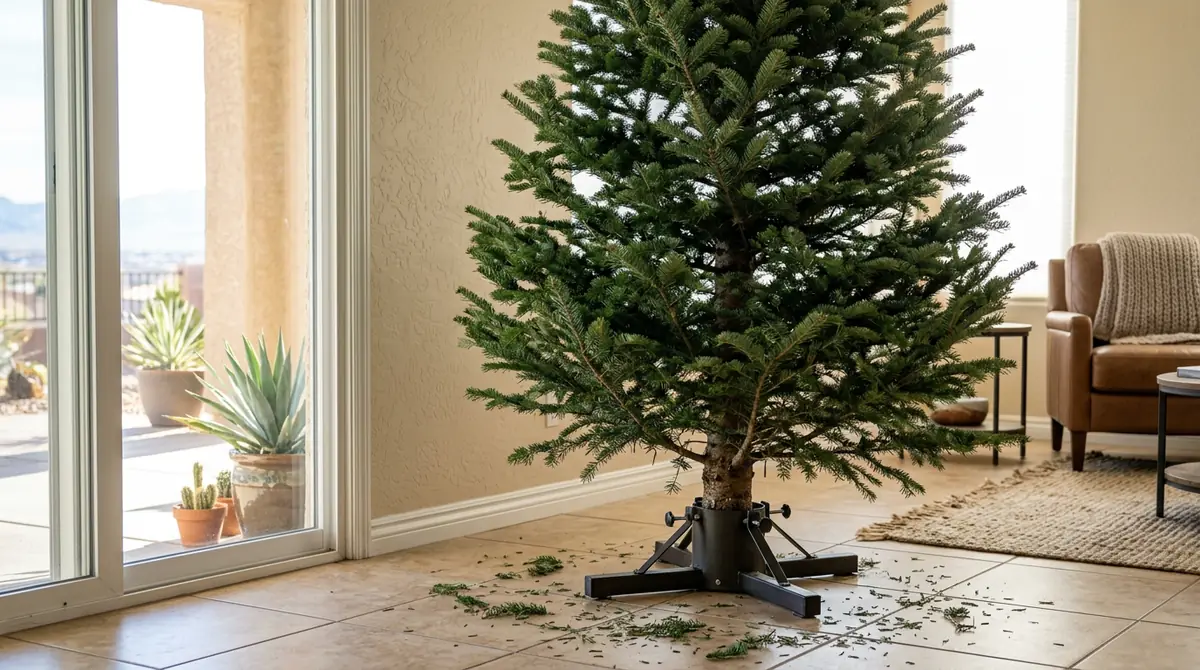
Yes, a real Christmas tree can bring mold into a Las Vegas home. Cut trees carry mold spores on their needles, branches and bark, and allergists have measured airborne spore counts climbing in a room for as long as a live tree stayed up. For most people that means nothing. For anyone with a mold allergy or asthma, it can mean weeks of sneezing that start the week the tree goes up. The useful question is whether the tree is the whole story, or whether it is adding to mold the house already had.
Why people call it Christmas tree syndrome
Christmas tree syndrome is the informal name for allergy symptoms that start after a live tree comes indoors. UCLA Health describes it as weeks of sneezing, congestion and watery eyes that affect a small percentage of people, and notes that most of them are reacting to mold, dust or pollen carried on the tree rather than to the tree itself. Of those, UCLA Health calls mold the biggest nuisance.
The American College of Allergy, Asthma and Immunology (ACAAI) says the same thing more briefly: some live trees still have mold spores and pollen on them, which can cause nasal allergies to flare. Fresh fir sap can also cause skin reactions in people sensitive to terpene, which is a separate problem from mold.
The symptoms match what the EPA lists for mold allergy in general: sneezing, runny nose, red eyes and skin rash. That overlap is why a live tree and a hidden mold problem in the house are easy to confuse.
What researchers found in the air around a live tree
The best-known measurement comes from Connecticut allergists who presented their work at the ACAAI annual meeting. They counted airborne mold spores in one home with a live Christmas tree over two weeks. For the first three days, the count stayed at about 800 spores per cubic meter of air, slightly above normal. It then kept rising and reached 5,000 spores per cubic meter by day 14, when the tree was removed.
One of the authors put normal indoor levels at under 1,000 spores per cubic meter. The study was small: one tree in one house, with no check of which molds were present or whether they caused anyone's symptoms. Other allergists quoted at the time said more research was needed. What it does show is the direction: the longer the tree stood in the room, the more spores were in the air.
Why a dry Las Vegas house does not cancel the problem
It is reasonable to assume a desert home is too dry for a tree to matter. But the spores on a cut tree do not need to grow inside a Las Vegas house to cause symptoms. They arrive already formed on the needles and bark, and they become airborne as the tree is carried in, shaken, decorated and brushed past. The EPA notes that mold spores float through outdoor and indoor air and that it is impossible to get rid of all of them indoors. Dry air does not stop a spore from being inhaled.
A live tree also brings water into the room. The stand holds a reservoir that has to stay filled for the tree to stay fresh and less flammable, and it sits under a skirt where nobody looks at it for a month. Add a winter humidifier running in the same room and the space around the tree is wetter than the rest of the house. The EPA advises keeping indoor humidity below 60 percent (ideally between 30 and 50 percent). If you run one this time of year, see when a winter humidifier starts feeding mold in a Las Vegas home.
How long the tree stays up is the part you control
Because the spore count in that study climbed day after day, the length of time a live tree stays indoors matters. UCLA Health puts it plainly: the longer the tree stays in your home, the higher the mold spore count can get.
For mold-sensitive people, co-author Philip Hemmers advised keeping a live tree indoors for only four to seven days. That is a short holiday for a tree bought the weekend after Thanksgiving. If someone in the house has a known mold allergy or asthma, the realistic choices are a shorter display, a tree set up later in December, or an artificial tree. UCLA Health also suggests fir, spruce or Leyland cypress if pine in particular is a trigger.
Steps that cut the spores before the tree comes inside
Allergists recommend a few simple steps for a live tree in a Las Vegas home:
- Shake and rinse it outside. The ACAAI advises that you rinse off live trees before you bring them in. UCLA Health adds shaking the tree to loosen debris, or using an air compressor.
- Let it dry fully first. A tree rinsed in the driveway should dry in the garage or on a covered patio before it comes inside, so you are not carrying wet branches into the living room.
- Have someone without allergies set it up. UCLA Health suggests long sleeves and gloves for anyone who has to handle it.
- Run an air purifier in that room. UCLA Health recommends it; an allergist quoted by HealthDay noted it could help in theory but has not been studied for trees.
- Clean stored decorations and artificial trees. The ACAAI says to clean an artificial tree and decorations used every year to remove dust and potential mold. Boxes kept in a hot garage or a closet near a water heater are worth opening outdoors.
An artificial tree is not automatically the clean option. Stored most of the year in a damp box, it can collect dust and mold of its own. Store it in a sealed container in a dry place, as UCLA Health suggests.
When symptoms point to something besides the tree
The tree is a reasonable first suspect when symptoms start within days of it going up and are worst in that room. It becomes a weaker explanation when:
- Symptoms continue after the tree is out of the house and the room has been vacuumed.
- The same sneezing, congestion or headaches came back last spring or summer, with no tree involved.
- One room smells musty, especially a bathroom, a laundry room, a closet on an exterior wall or a guest room that stays closed.
- The home had a leak, a burst pipe or a stained ceiling in the past year.
- Someone is reacting in a room the tree was never in.
Each of those suggests a moisture source inside the house. A musty smell in particular is worth taking seriously; see why strange indoor odors are a warning sign. If anyone has asthma or symptoms that do not ease, a doctor or allergist should be the first call, since mold is only one possible cause.
What an indoor air test shows that guessing cannot
Removing the tree and waiting tells you whether the tree was part of the problem. It does not tell you whether the house has a mold source of its own. An indoor air quality inspection answers that directly. Air samples taken inside the home are compared with an outdoor sample collected the same day, and a lab identifies the mold types and counts in each. When indoor counts are higher than outdoors, or show molds that are not in the outdoor air, the source is inside the house, whether or not the tree is still there.
The EPA notes that no federal limits exist for mold, and that if visible mold growth is present, sampling is unnecessary. Testing is most useful in exactly the situation this post describes: symptoms, maybe a smell, and nothing you can see. Timing helps too. Testing after the tree has been out for a while separates what the tree added from what the house produces on its own.
The Total Home Health Inspection from Las Vegas Mold Testing combines indoor air sampling with a visual and moisture check of the home, and the samples are analyzed by an accredited lab. Las Vegas Mold Testing does not perform remediation, so the report has no reason to find more than is there. If the sneezing outlasted the tree, schedule an indoor air test with Las Vegas Mold Testing, serving Las Vegas, Henderson, Summerlin, North Las Vegas and Pahrump.
Call (702) 766‑8030 to book an indoor air test. You receive a written report with the lab results, whatever they show.