A brown or yellow ring that appears on a Las Vegas ceiling after a winter storm almost always means water came through the roof, a roof penetration or a drain line and soaked into the drywall from above. The stain itself is not mold. The real questions are whether the drywall, framing and insulation above it are still wet, and whether they stayed wet long enough for mold to start. A thermal scan confirmed with a moisture meter answers the first question without cutting the ceiling open, and it tells you whether a mold test is worth paying for at all.
The rest of this guide covers why winter storms find leaks that summer storms missed, how to judge whether a stain is active, and the order of calls that keeps you from paying for the same ceiling repair twice.
Why winter storms find roof weak spots that summer storms missed
Summer monsoon storms in Las Vegas tend to arrive as short, heavy bursts. Water hits the roof hard and drains off fast. Winter storms behave differently. They are more likely to bring slower, steadier rain over many hours, often pushed sideways by wind, and the cooler air means a wet roof stays wet much longer before the sun dries it.
That combination finds different weak spots. Wind-driven rain gets pushed up under roof tiles, behind flashing at walls and chimneys, and around vent pipes and skylight curbs. Steady rain gives that water time to work through a tired seal that would have shed a quick summer downpour. That is why a Las Vegas home can get through monsoon season with a dry ceiling and still show a fresh stain after the first long winter rain.
Tile roofs, aging underlayment and flat roof drains
Most Las Vegas homes have concrete or clay tile roofs. The tiles shed most of the rain, but they are not the waterproof layer. The underlayment beneath the tiles is what actually keeps water out of the attic. Desert heat and sun break that underlayment down over time, and a cracked or slipped tile lets wind-driven rain reach it directly. When the underlayment fails, water can travel along it and drip into the attic some distance from where it got in, so the ceiling stain is not always directly below the problem on the roof.
Flat and low-slope roofs, common on patio covers, additions and some older Las Vegas homes, have a different weak point: the drains and scuppers. Leaves, dust and roofing grit collect in them over the dry months. When a winter storm hits, a partly blocked drain lets water pond on the roof and find any seam or penetration nearby.
Not every winter ceiling stain is a roof leak. An HVAC unit or water heater in the attic, a condensate line or a plumbing vent can also send water into a ceiling. Knowing which one it is matters, because it decides whether you need a roofer, a plumber or an HVAC technician.
Is the ceiling stain still wet, or an old mark that just showed up?
A ceiling stain can be active, meaning water is still in the drywall and the materials above it, or it can be an old, dry mark from a past leak that you are only now noticing. A few signs point one way or the other:
- Likely still wet: the stain grew after the most recent rain, the edges look darker than the center, the drywall feels soft or sags, paint is bubbling, or there is a musty smell in that room.
- Possibly old: the stain has sharp, dry edges, has not changed size across several storms, and the surface feels firm and room temperature.
Those signs are a starting point, not an answer. Drywall can feel dry on the room side while the top surface, the framing and the insulation above it are still holding water. Timing is what makes the difference: according to the EPA's guide to mold and moisture, wet materials that are dried within 24 to 48 hours will usually not grow mold. A ceiling that has been wet since the storm, with no airflow above it, is well past that window.
What a thermal scan shows that a ladder and flashlight cannot
Looking into the attic with a flashlight shows you the surface of the insulation and whatever is in reach. It does not show how far the water spread under the insulation, along the top of the drywall or down a ceiling joist. The EPA lists roof materials above ceilings as a common place for hidden mold from roof leaks, and notes that investigating hidden mold can be difficult and may require a professional.
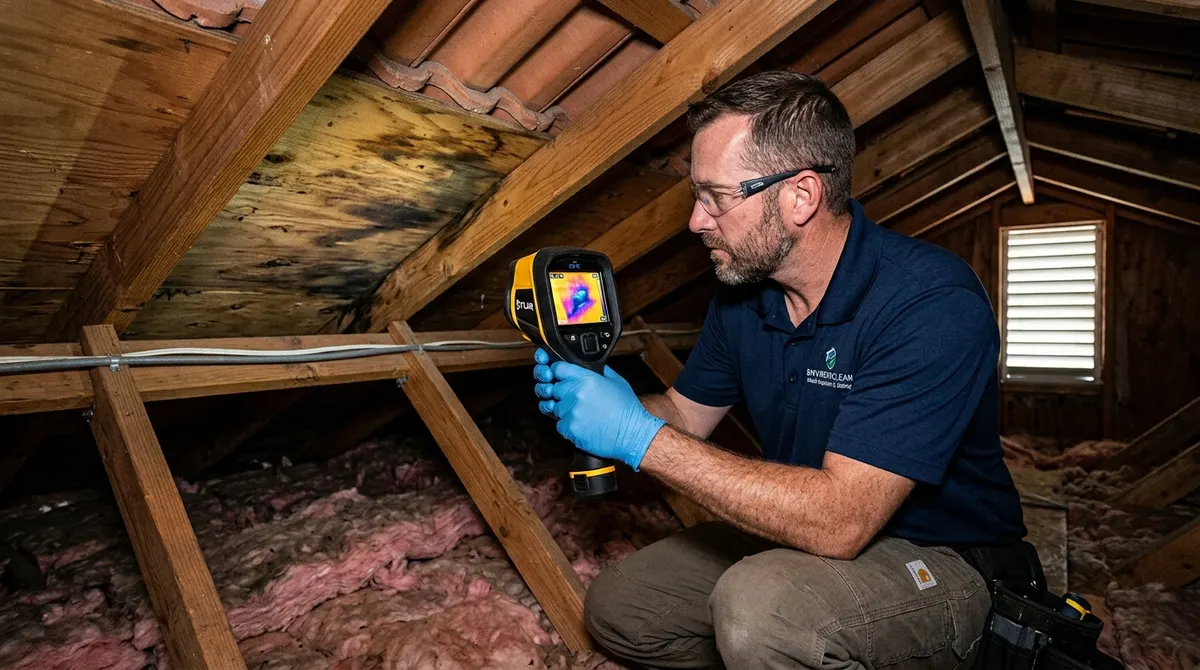
A FLIR thermal imaging inspection scans the whole ceiling from the room below and the roof deck from the attic. Wet drywall, framing and insulation hold and release heat differently than dry materials, so the wet area shows up as a cooler patch with a shape and an edge. That outline is often larger than the visible stain. Each suspect area is then checked with a moisture meter, because a thermal camera reads temperature, not water, and things like missing insulation or an air leak can look similar on screen. The result is a map of where the ceiling is actually wet, not a guess based on the stain.
That map is what tells you whether a mold test makes sense. If the ceiling and attic read dry, the stain is likely old or the area dried in time, and you can move on to the repair. If materials are still wet, or the scan shows a wide wet area above a small stain, air or surface sampling can confirm whether mold has started before anything is cut out.
Roofer, drywall patch or mold test: the order that saves money
The most expensive mistake with a ceiling stain is fixing things in the wrong order. Painting over a stain that is still wet hides the problem until it comes back. Replacing drywall before the roof is fixed means replacing it again after the next storm. This order avoids paying twice:
- Stop the water. Call a roofer, or a plumber or HVAC technician if the source is a line or unit in the attic. The repair has to come first.
- Find out what is still wet. A thermal scan with moisture readings shows how far the water spread above the ceiling, including areas you cannot see from the room.
- Test for mold only where it makes sense. If materials stayed wet or there is a musty smell, sampling tells you whether mold started and how much material may need to go. If you can already see mold, the EPA notes that sampling is usually unnecessary, and the next step is cleanup.
- Dry, clean and repair. The EPA says porous materials such as ceiling tiles may have to be thrown away if they become moldy, and that areas larger than about 10 square feet call for its professional remediation guidance.
- Confirm before closing up. Before new drywall and paint go up, an independent water and mold repair verification confirms the area is dry and clean so the stain does not return.
For more on why the inspection comes before any removal work, see whether to call a mold inspector or a remediator first.
When a ceiling stain means the attic insulation needs a closer look
Attic insulation in Las Vegas homes is usually loose fill or fiberglass batts lying directly on top of the ceiling drywall. When a roof leak drips onto it, the insulation soaks up the water, holds it against the drywall and keeps it out of the air, so it dries far more slowly than the roof deck above. That is why a ceiling can keep staining or smelling musty long after the roof stops leaking.
The insulation deserves a closer look when the stain is large or keeps growing, when there is more than one stain along the same run of ceiling, when the leak went on through several storms before anyone noticed, or when the room smells musty. In those cases, a thermal scan of the attic and moisture readings in the insulation and framing show whether the insulation needs to be pulled back, dried or replaced. Wet insulation over a living space is also a reason to check the air in that room, since mold growing above a ceiling can still reach the space below through light fixtures, vents and gaps.
The same applies to anyone buying a Las Vegas home this winter. A fresh paint patch on a ceiling below a tile roof is worth asking about, and a mold test during escrow can include a thermal scan of that spot.
Get a straight answer about a ceiling stain in Las Vegas
Las Vegas Mold Testing finds where water went and whether mold followed. We do not sell roofing, drywall or mold removal, so the report tells you what is wet, what is not, and whether testing is needed, without a repair pitch attached. Our FLIR thermal imaging inspection covers homes across Las Vegas, Henderson, Summerlin, North Las Vegas and the rest of the valley.
If a ceiling stain showed up after the rain, contact Las Vegas Mold Testing to schedule a thermal scan before you patch, paint or replace anything.